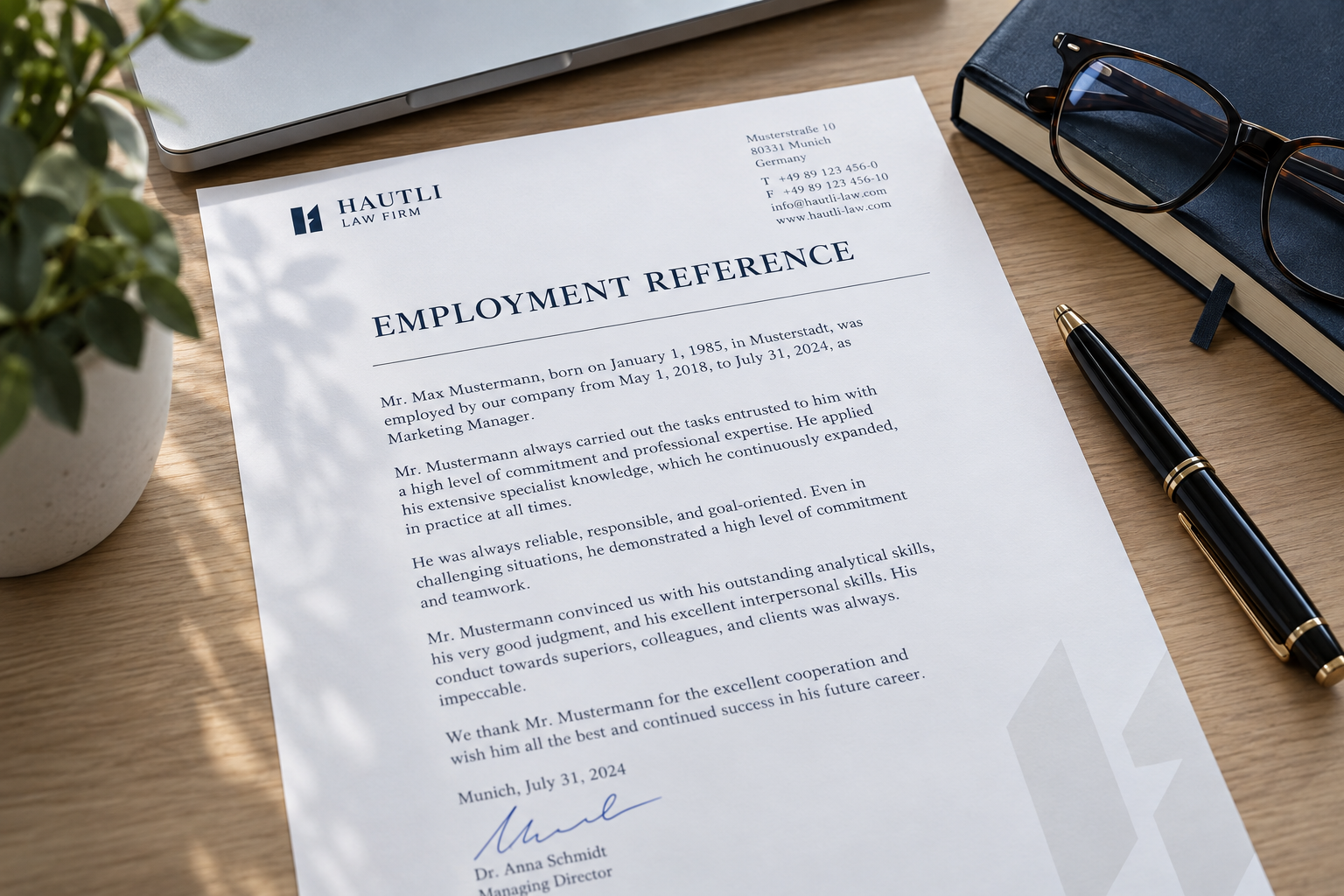
A Employment Reference can play an important role in your future career. It is often a key part of a job application and gives prospective employers an impression of your performance, conduct and qualifications.
However, not every employment reference is as positive as it may appear at first glance. Friendly-sounding wording can conceal hidden assessments or indications that may have a negative impact on future job applications.
As a lawyer in Freiburg, I review your employment reference, explain the meaning of the wording used, and assist you in securing an appropriate assessment.
What is an Employment Reference?
A Employment Reference is a written assessment by the employer relating to the employment relationship. As a general rule, employees are entitled to an employment reference when their employment ends.
A distinction is made in particular between:
- simple employment reference: contains information about the employee as well as the type and duration of employment
- qualified employment reference: additionally includes an assessment of performance and conduct
In practice, the qualified employment reference is usually the more important document, as it enables prospective employers to assess the employee’s previous work and performance.
Am I Entitled to a Good Employment Reference?
An employment reference must generally be truthful and benevolent in its wording. The employer may not provide false information, but at the same time should not unnecessarily hinder the employee’s future career prospects.
It is precisely this balance that frequently gives rise to disputes. Many references contain wording that sounds positive but may in fact express a weaker assessment.
For this reason, it can be worthwhile having your employment reference reviewed carefully.
Wording in Employment References: Is There a Secret Reference Code?
Many employees wonder what grade their employment reference actually represents. Over time, certain standard phrases have developed that may correspond to particular assessments.
Beispiele:
- “always to our fullest satisfaction” – very good assessment
- “always to our full satisfaction” – good assessment
- “to our satisfaction” – may already be understood as a significantly more critical assessment
However, the employment reference must always be considered as a whole. Individual phrases should not be assessed in isolation.
The order of statements, omitted assessments, or unusual wording can also affect the overall impression created by an employment reference.
What Can I Do About a Poor Employment Reference?
If an employment reference contains errors or is inappropriate, employees do not simply have to accept it.
Depending on the circumstances, it may be possible to request that:
✓ incorrect information be corrected
✓ ambiguous wording be changed
✓ important duties be added
✓ a better assessment of performance or conduct be included
In many cases, an improvement can already be achieved through out-of-court communication with the employer.
When Should I Have My Employment Reference Reviewed?
A legal review is particularly advisable if:
- you are unsure what grade your reference actually reflects
- important responsibilities or achievements are missing
- unusual wording is used
- the reference appears unusually short or impersonal
- you receive a reference following a termination or termination agreement
Particularly when an employment relationship is ending, the employment reference may also form part of broader negotiations – for example, together with a severance payment or termination agreement.
A good employment reference can be crucial to your future career. You should therefore know what impression your reference actually creates.
I will review the following for you:
✓ What assessment does your employment reference really contain?
✓ Are there any problematic or hidden formulations?
✓ Are you entitled to have the reference amended or improved?
✓ What is the best way to approach your employer?